Digital Impressions
Jupiter, FL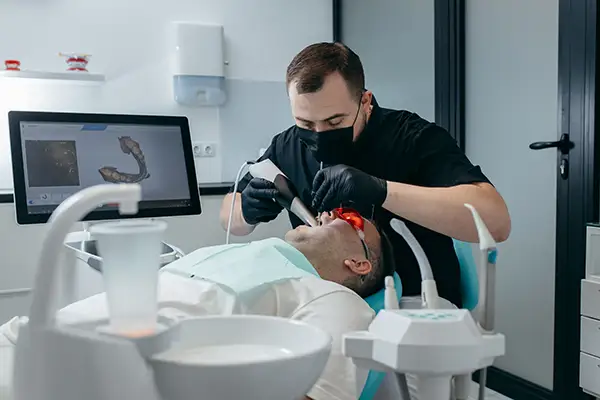
Prosthodontic care often involves some of the most demanding cases in dentistry: full-arch reconstructions, implant-supported bridges, multi-unit restorations, and cases where a patient's bite, jaw position, and remaining teeth must all be accounted for at once. At Roy C Blake, III, DDS MSD, Maxillofacial Prosthodontist, digital impressions have become a foundational part of how Dr. Blake plans and executes this level of restorative work, giving the entire treatment process a level of accuracy that was difficult to achieve with older impression methods.
How Digital Scanning Fits Into Complex Treatment Planning
A digital impression begins with an intraoral scanner capturing a detailed 3D map of the teeth, gums, and bite relationship. For straightforward cases, this data alone may be enough to move forward with a restoration. For prosthodontic cases, though, this scan is often just the starting point of a much larger digital workflow.
The scan data can be layered with information from cone beam CT imaging, giving Dr. Roy Blake a combined view of both the soft tissue surface and the underlying bone structure. This is particularly valuable when planning implant placement, evaluating bone density and volume, or determining how a full-arch prosthesis will need to be designed to fit the patient's unique anatomy. Rather than working from separate physical models and X-ray films, the entire case can be visualized digitally, in one coordinated file.
Coordinating With Dental Laboratories
Complex restorations typically involve close collaboration with a dental laboratory, and digital impressions have changed how that collaboration works. Once a scan is captured, the file is sent electronically, arriving at the lab within moments rather than days. There is no risk of a physical model shifting, cracking, or being damaged in transit, which matters considerably when a case involves multiple abutments, a full-arch framework, or a custom attachment system for an implant-supported denture.
This direct digital connection also allows for more detailed communication between Roy C. Blake III, DDS, MSD, Maxillofacial Prosthodontist and the lab technicians building the restoration. Notes, margins, and specific design considerations can be marked directly on the 3D file, reducing the chances of miscommunication that might otherwise require a remake or a return visit.
Improving Fit for Multi-Unit and Full-Arch Cases
The more units involved in a restoration, the more small inaccuracies can compound. A slight distortion in a single-crown impression might result in a minor adjustment. That same distortion across a full-arch implant bridge can affect how the entire prosthesis seats, how force is distributed across the implants, and how the bite functions once the restoration is delivered.
Digital scanning reduces this risk considerably. Because the scanner captures data continuously and can be reviewed in real time, Dr. Roy Blake is able to check for gaps or inconsistencies in the scan before it is ever sent for fabrication. If an area needs to be recaptured, it can be rescanned in seconds, without redoing the entire impression.
Monitoring Changes Over Time
For patients receiving prosthodontic care, treatment is often not a single appointment but an ongoing process that may span several visits, or even several years for patients maintaining implant-supported restorations long term. Digital impression files are stored electronically, which allows Dr. Roy Blake to compare scans from different points in treatment.
This is useful for tracking how tissue around an implant has healed, whether a removable prosthesis is still fitting as intended, or whether a patient's bite has shifted in a way that warrants a closer look. Having a digital record eliminates the need to rely on memory or physical models that may have degraded, and gives both the practice and the patient a clearer picture of how treatment is progressing.
A More Comfortable Experience for Patients Facing Extensive Work
Patients undergoing prosthodontic treatment often need more impressions taken over the course of care than the average dental patient, whether for provisional restorations, try-in fittings, or final impressions. Traditional impression material, taken repeatedly across multiple appointments, can become genuinely difficult for patients to tolerate, particularly those with a strong gag reflex or limited jaw mobility.
Digital scanning removes much of this burden. There is no material to place in the mouth, no waiting for it to set, and no risk of a scan needing to be redone due to the patient moving before the material hardens. For patients who already have significant restorative needs, this can make an already involved treatment plan considerably easier to manage from start to finish.
What Patients Should Know Before Their Appointment
Patients preparing for a digital impression at Roy C. Blake III, DDS, MSD, Maxillofacial Prosthodontist do not need to do anything differently. There is no special preparation required beforehand, and the scan itself typically takes only a few minutes to complete. Dr. Roy Blake will walk through the resulting 3D model with the patient chairside, which gives patients a clearer understanding of their own anatomy and the reasoning behind their treatment plan.
For patients with implants already in place, or those being evaluated for future implant placement, this visual review is often one of the more informative parts of a prosthodontic consultation, offering a level of transparency that was not possible with traditional impression methods.
Schedule a Consultation
If you are considering implant-supported restorations, a full-arch prosthesis, or another form of advanced restorative care, Roy C. Blake III, DDS, MSD, Maxillofacial Prosthodontist can walk you through how digital impressions support every stage of that process. Call (561) 296-3399 to schedule a consultation with Dr. Roy Blake and find out what a coordinated, digitally planned approach to your treatment can look like.
|